Operating Temperatures Down to -270°C
Cryogenic Bearing Solutions
From aerospace satellites to cryogenic pumps, from Mars rovers to liquid helium equipment — extreme low-temperature environments impose stringent requirements on bearing material toughness, lubricant low-temperature stability, thermal contraction compensation, and seal reliability. myonic's cryogenic bearing technology has been proven in NASA Mars exploration missions with service beyond design life, providing complete solutions from -40°C to -270°C.
Critical challenges in cryogenic environments
Below -40°C, failure modes for conventional bearing materials and lubrication systems increase dramatically.
Lubricant Solidification
Standard mineral greases begin to lose fluidity below -40°C and completely solidify (wax-like) at deep cryogenic temperatures (approximately -190°C), causing startup torque to spike or the bearing to seize. A switch to MoS₂ or WS₂ solid lubrication, or specialized designs using the cryogenic refrigerant itself as the lubricating medium, is required.
Material Embrittlement
Ordinary bearing steel exhibits an increased ductile-to-brittle transition temperature at low temperatures, with decreased impact toughness and risk of brittle fracture. SV30 nitrogen-enhanced martensitic steel offers better low-temperature fatigue life and wear resistance; silicon nitride (Si₃N₄) ceramic balls also perform excellently at low temperatures with an extremely low thermal expansion coefficient.
Thermal Contraction Mismatch
Bearing rings, balls, and housing materials have different thermal expansion coefficients, resulting in significantly different contraction rates at low temperatures. Aluminum alloy housings contract far more than steel bearings, potentially causing over-tight fits and loss of internal clearance. Cryogenic bearings must be designed with sufficient radial clearance at room temperature to compensate for contraction differences.
Seal Failure
Standard rubber seals (NBR, silicone) lose elasticity at deep cryogenic temperatures, forfeiting their sealing function or even cracking. Cryogenic applications require PCTFE, PTFE, or special low-temperature elastomer materials, or fully open designs with solid lubrication, to avoid contamination or seizure from seal failure.
Purpose-engineered for cryogenic environments
myonic provides cryogenic bearing solutions spanning the full range from -40°C to -270°C, covering critical application sectors including aerospace, chemical, and semiconductor industries.
Specialty Cryogenic Lubricants & Solid Coatings
Addressing the core challenge of conventional lubricant solidification at low temperatures, myonic provides multiple dry solid lubrication solutions that maintain effective lubrication at liquid helium temperatures down to -270°C.
- MoS₂ / WS₂ solid lubrication: remains effective in cryogenic environments when conventional greases solidify
- PVD silver (Ag) coating: magnetron sputtered, covering complex 3D bearing geometries
- Special low vapor pressure lubricants: suitable for combined cryogenic and vacuum environments
- Media lubrication design: using liquid nitrogen, liquid helium, or cryogenic refrigerants as the lubricating medium
- Minimum operating temperature: -270°C (liquid helium)
Cryogenic-Grade Materials — Ceramic Balls & Specialty Cages
The material combination for cryogenic bearings requires precise selection based on low-temperature characteristics. myonic offers customized configurations of silicon nitride ceramic balls, SV30 cryogenic steel, and specialty cage materials.
- Silicon nitride (Si₃N₄) ceramic balls: low thermal expansion coefficient, far superior reliability to steel balls at low temperatures
- SV30 nitrogen-enhanced martensitic steel: improved low-temperature fatigue life and wear resistance
- Cage materials: PEEK, PCTFE, PAI — maintaining elasticity and strength at low temperatures
- Room-temperature radial clearance reserve design: compensates for low-temperature thermal contraction, preventing seizure
- Satellite standby mode design: reliable instant startup after years to decades of dormancy
Full Ceramic Bearings — Extreme Cryogenic Applications
Full ceramic bearings (Si₃N₄ rings and balls) offer the best dimensional stability, embrittlement resistance, and chemical inertness at extreme low temperatures — ideal for cryogenic pumps, liquid gas equipment, and other applications with direct cryogenic media contact.
- Full Si₃N₄ ceramic construction: rings and balls are all ceramic, eliminating galvanic corrosion between metals
- Extremely low thermal expansion coefficient: excellent dimensional stability at low temperatures, reducing clearance calculation margins
- Cryogenic media resistant: can operate directly in liquid nitrogen or liquid helium
- Non-magnetic, non-electrically conductive: suitable for electromagnetic-sensitive applications
Real-world cryogenic bearing applications
The following showcases typical scenarios and technical highlights of miniature bearings in cryogenic applications across industries.

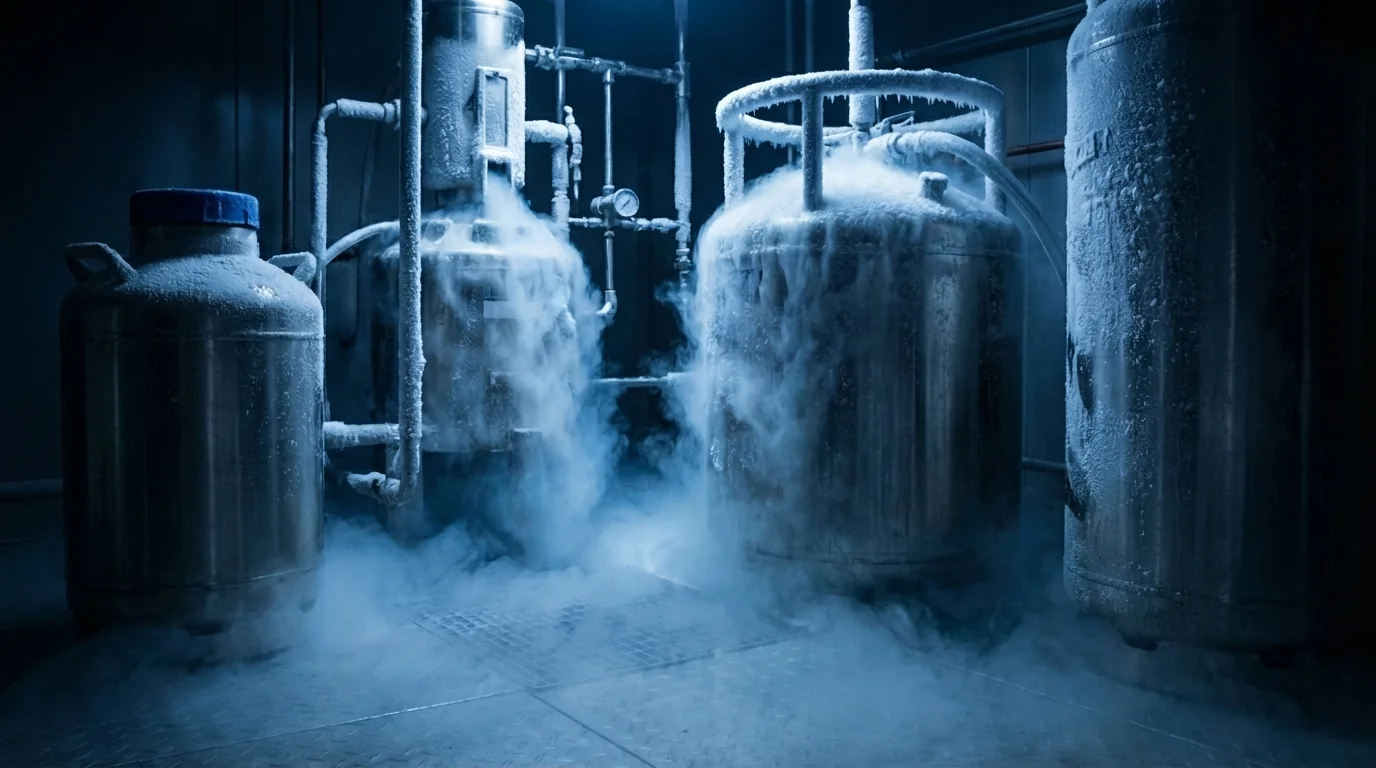

Some images on this page are AI-generated illustrations used where authentic photographs are not readily available. They are for visual reference only and do not represent actual product appearance or specifications.
Need a miniature bearing solution?
Our engineering team can help with selection and custom design