Product Overview
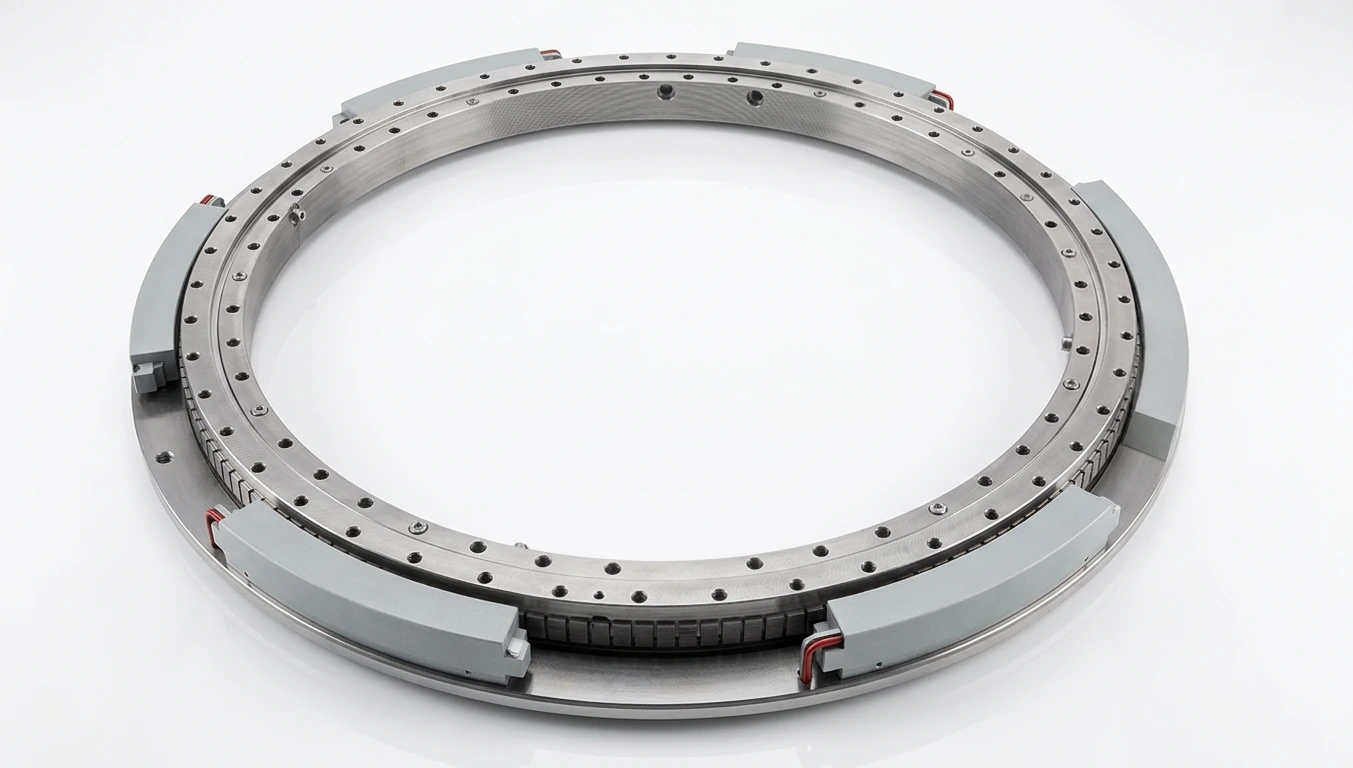
Rotary direct drive on a large scale: a torque motor built from multiple segments (Motor with 10 segments)
The torque motor has established itself as the drive of rotary axes for machine tools. The advantages of the torque motor against transmission solutions have significantly improved the dynamics and control quality of these machine tool axes. No abrasive wear and the extensive range of sizes make the torque motor versatile. The segmented design of the motor components in a drive system is, in larger diameters, also an economical solution.
Design
Rotary direct drives, also known as torque motors, consist of a primary and a secondary part. The primary part contains an active winding system, while the secondary part features a permanent magnet system. In concentric systems, the rotor can be either the internal or the external ring (internal or external rotor).
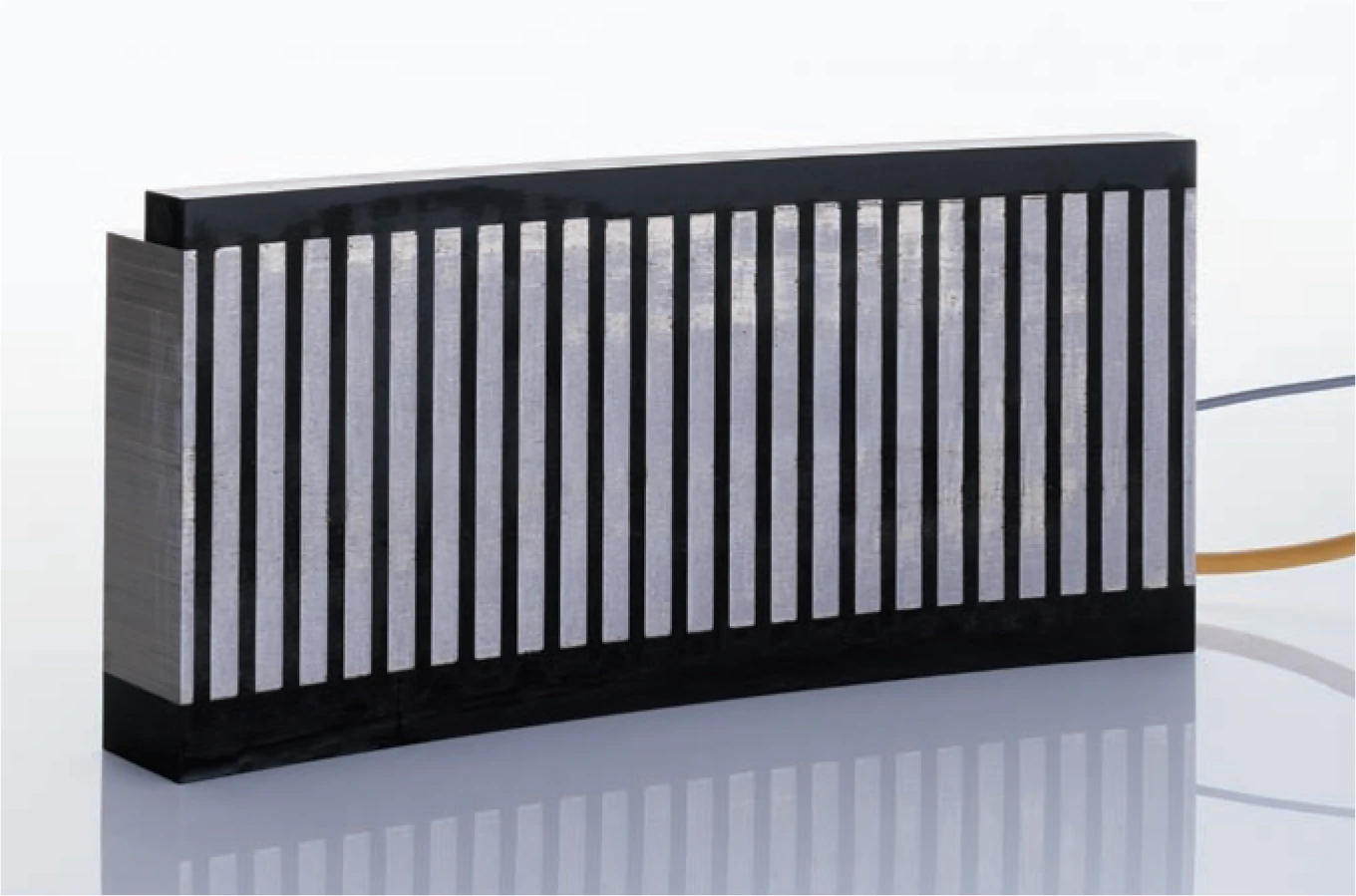
A single segment of the primary part: every segment / motor housing has its own cable connection
Coil winding systems that are grouped and installed in individual motor housings represent the specific feature of a segmented motor. Every individual segment / motor housing has its own cable connection and is wired to the other segments externally in cable terminal boxes. All individual segments combined add up to the entire motor (primary part).
The basic structure of these segments is identical. Each segment generates a feed power appropriate to its magnet height. This height can be adjusted between 25 mm and 200 mm in steps of 25 mm, so that the smallest segment generates a power of about 560 N and the largest one 4500 N.
Features, Advantages and Applications
Features
- Segmented design of primary and secondary part
- Number of used primary part segments according to the requirements
- Ease of handling and assembly
Advantages
- Scalable torque by varying the number of segments
- Very large diameters can be realized economically
- Exchange of single segments without failure of the motor
Applications
- Rotary tables in automation and packaging technology
- NC rotary tables for turning, grinding or milling
Drawing
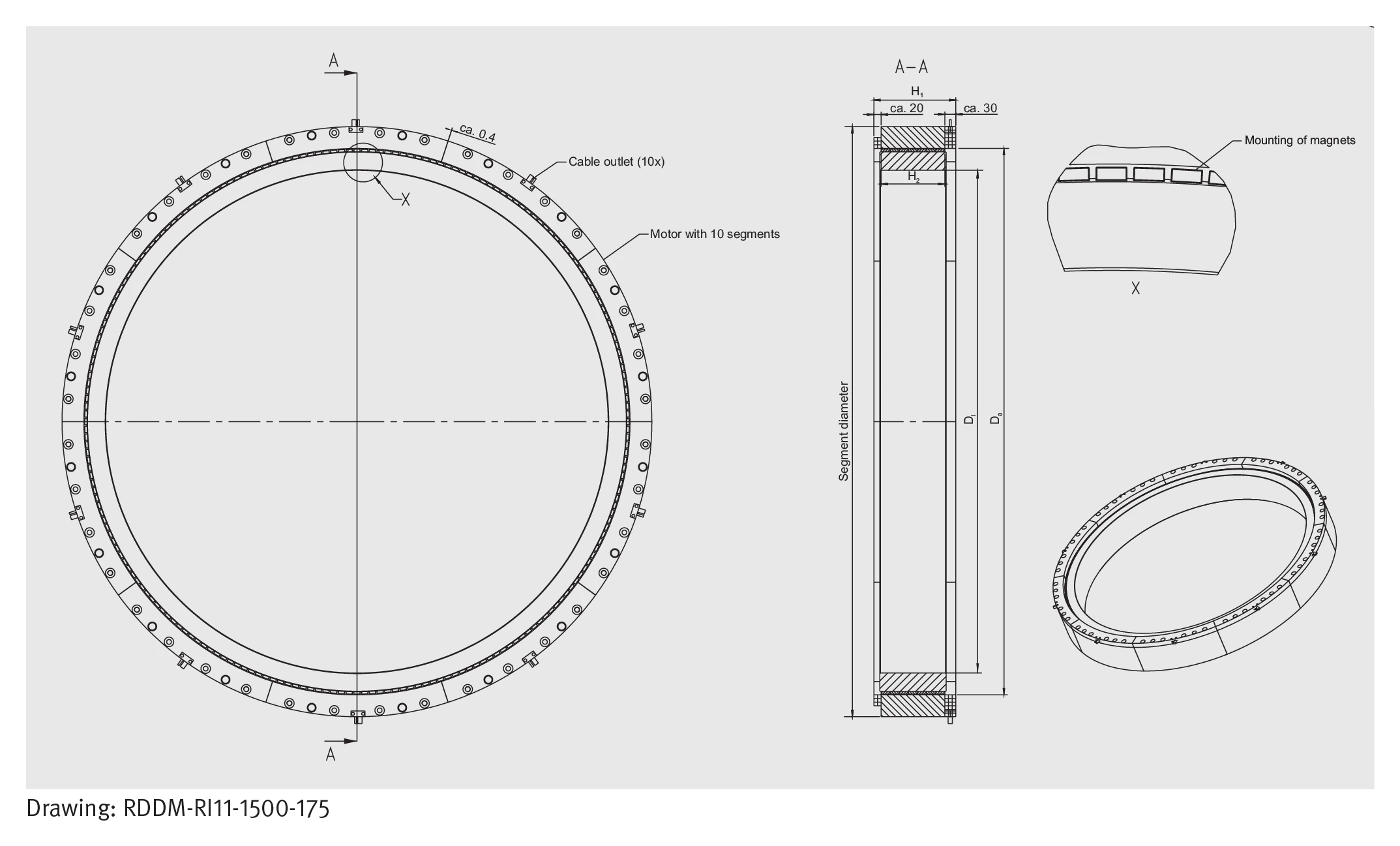
Drawing: RDDM-RI11-1500-175 (configuration with 10 segments, 10x cable outlet, H1 / H2 in section A–A, mounting of magnets)
Technical Data
The following 3 sizes are the base for scalable performance by varying the motor height.
| Technical data | Symbol | Unit | RI11-3P 1500x175 | RI11-3P 1920x200 | RI11-3P 3250x175 |
|---|---|---|---|---|---|
| Average diameter air gap | Da | mm | 1500 | 1920 | 3250 |
| Inner diameter | DI | mm | 1350 | 1750 | 3000 |
| Outer diameter | DA | mm | 1750 | 2150 | 3500 |
| Height primary part | H1 | mm | 235 | 260 | 260 |
| Height secondary part | H2 | mm | 175 | 200 | 175 |
| Peak torque | Tp | Nm | 36506 | 73514 | 182575 |
| Continuous torque - cooled | Tcw | Nm | 29959 | 56061 | 135739 |
| Continuous current - cooled | Icw | Arms | 203.1 | 134.0 | 180.9 |
| Motor constant | km | Nm/√W | 244.0 | 416.0 | 494.9 |
| Max. speed at Icw | nmax | rpm | 29 | 11 | 6 |
| Number of segments | — | pcs. | 10 | 12 | 21 |
Subject to modification without previous notice. IDAM will provide additional specifications, drawings and tolerance ranges per customer request. IDAM recommends that all motor applications be reviewed by an IDAM specialist. Other sizes on request.