1.4.1 Definition
SCHNEEBERGER MONORAIL guideways exhibit an elastic deflection behaviour which is not linear but degressive. That means that the rolling elements are relatively supple under minimal force and become more rigid with increasing force. The guideways are preloaded by the preload and so part of the elastic deformation has already been removed. Consequently, the rigidity of the overall system is increased.
The following figure shows the influence of preload on the deflection behaviour based on the example of a ball.
The preload:
- Changes the rigidity and thus also the natural frequency of a guide system
- Influences the travel pulsation of the carriage
- Increases the displacement resistance of the carriage
- Increases the load acting on the carriage and thus reduces the nominal service life. When calculating the service life the preload therefore needs to be taken into account as an additional force.
The selection of preload is thus always a compromise between rigidity, displacement resistance and service life, and needs to be weighed up depending on the application. For this reason SCHNEEBERGER offers four different preload classes V0, V1, V2 and V3.
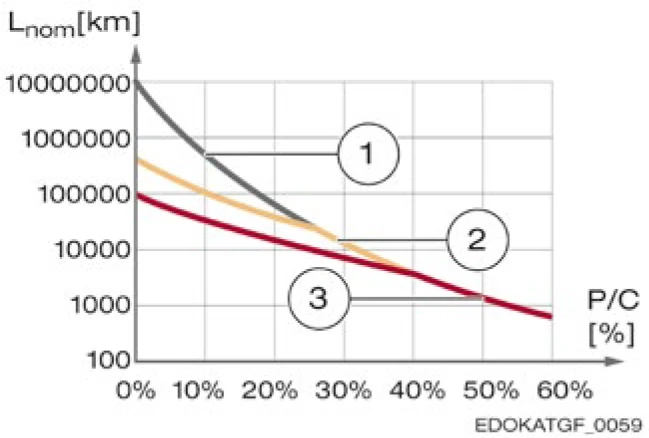
Nominal service life as a function of preload and force based on the example of an MR 45 roller guideway. Ratio P/C (%) with equivalent force P (N) and dynamic load capacity C (N) is applied against the nominal service life Lnom (km).
1 low preload, V1 2 medium preload, V2 3 high preload, V3 Lnom nominal service life P equivalent force C dynamic load capacity
1.4.2 Generating
The preload V in the carriage is created by using rolling elements with an interference fit. This means the rolling element diameter is bigger than the clearance between the guide rail and carriage by a few micrometers. As a result the flanks of the carriages are bent when being pushed on to a guide rail. The preload occurs due to the restoring force due to the elasticity of the carriage body. The magnitude of the preload force is set by selecting the corresponding rolling element diameter.
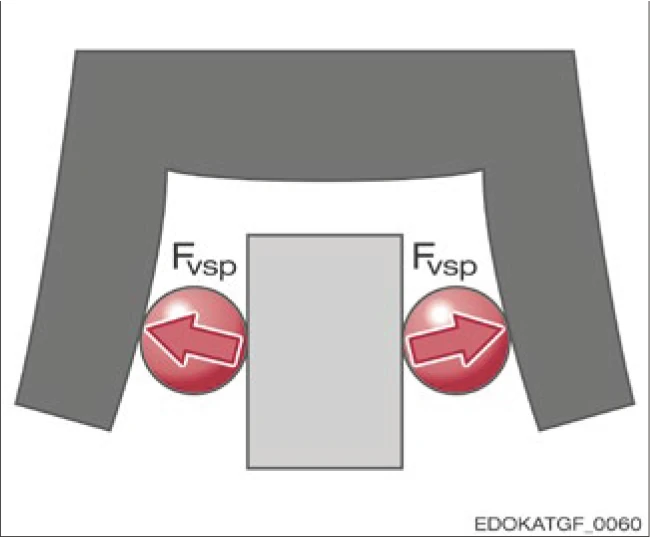
Preload force Fvsp generated by rolling elements, which acts against the carriage. The figure shows a finished ground carriage top.
1.4.3 SCHNEEBERGER MONORAIL guideways
Preload classes
SCHNEEBERGER offers three or four different preload classes for the MONORAIL guideways with roller and ball. See Section 4.5 - Preload.
Measuring preload
The preload not only generates a bulging of the flanks, but also a minor sag in the top of the carriage. This deformation of the top is proportional to the magnitude of the preload force and is therefore used to measure and check it.
Consistency of the preload
Caution — preload loss due to deformation of the carriage
To guarantee the preset preload following installation of the carriage, it is necessary to maintain the evenness specifications set out in this manual for the connecting structure. Otherwise it is possible that a loss of preload or an increase in preload occurs due to the deformation of the carriage when screwing tight.
One feature of the SCHNEEBERGER MONORAIL guideways is that the carriages have a level carriage top on any guide rail irrespective of the preload. Carriages with a different preload can be used on any guide rails. The set preload is maintained throughout.