Overview
Ballscrews for the highest demands
Mechanical engineering in its many variations, measurement technology and medical technology demand linear drives of the highest accuracy. Precision-ground ballscrews from Hipp are made for these requirements. Whether in production robots or in surgical microscopes, precise and fast linear movements can be realised with our ballscrews. Our developers will also work out an appropriate solution for your special requirements.
General information
General information
Ballscrews convert rotary motion to linear motion. Balls are the anti-friction element between the ballscrew spindle and nut. Ballscrew dynamics and positioning accuracy primarily depend on the accuracy of production and the technical implementation of the stipulated tolerances.
Advantages of ballscrews over leadscrews
- Considerably longer lifetime
- Very high traverse speeds
- Low heat generation
- No stick-slip effect
- Very high positioning accuracy
- Very high efficiency
- Less input power required
- No axial play with appropriate pre-loading
Thread profile
Thread profile
Our ballscrews have "Gothic arch" track profiles, which, with optimal relationship of ball diameter to track radius, generate a contact angle between spindle and nut of around 45°. This gives our ballscrews excellent running characteristics at maximum axial loads. The ball track profiles for all miniature ballscrews are ground after heat treatment using the most advanced machines.
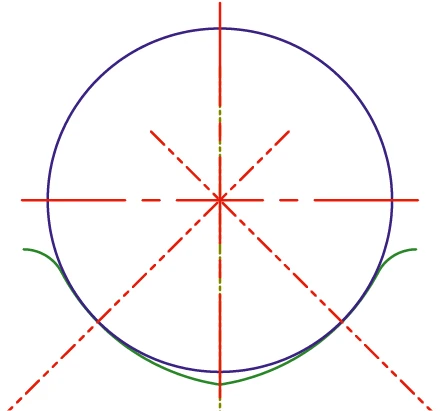
Gothic arch track profile with 45° contact angle
Nut systems
Nut systems
- Low-play single nut
- Anti-backlash pre-loaded single nut
- Anti-backlash pre-loaded double nut
- Spring pre-loaded double nut in the housing
Pre-loading
Pre-loading
The pre-loading force is the axial force within a nut system to increase positioning accuracy. As they are extremely precisely formed, our ballscrews can be pre-loaded as standard using the four-point system. Thus we attain optimum rating values.
Materials
Materials
We use the following materials as standard:
| Component | Material | Hardness |
|---|---|---|
| Ballscrew spindle | Cf53 | ball track hardened to 60 ±2 HRC |
| Ballscrew nut | 100Cr6 | hardened to 60 ±2 HRC |
| Balls | 100Cr6 | hardened to 60 ±2 HRC |
Stainless variants (on request):
| Component | Material | Hardness |
|---|---|---|
| Ballscrew spindle | 1.4112 | ball track hardened to 56 ±2 HRC |
| Ballscrew nut | 1.4034 | hardened to 56 ±2 HRC |
| Balls | 1.4034 | hardened to 56 ±2 HRC |
Note
In the stainless steel version, Cstat and Cdyn are reduced by about 20 percent.
Tolerance classes
Tolerance classes
Karl Hipp GmbH ballscrews are manufactured to tolerance classes 1 to 10 according to DIN ISO 3408. Tolerance classes and tolerances for useful travel lu correspond to ISO/DIS 286/1.
| Measuring length [mm] | IT1 [µm] | IT3 [µm] | IT5 [µm] | IT7 [µm] |
|---|---|---|---|---|
| – 315 | 6 | 12 | 23 | 52 |
| 316 – 400 | 7 | 13 | 25 | 57 |
| 401 – 500 | 8 | 15 | 27 | 63 |
| 501 – 630 | 9 | 16 | 30 | 70 |
| 631 – 800 | 10 | 18 | 35 | 80 |
| 801 – 1000 | 11 | 21 | 40 | 90 |
| 1001 – 1250 | 13 | 24 | 46 | 105 |
| 1251 – 1600 | 15 | 29 | 54 | 125 |
| 1601 – 2000 | 18 | 35 | 65 | 150 |
| 2001 – 2500 | 22 | 41 | 77 | 175 |
| 2501 – 3150 | 26 | 50 | 93 | 210 |
Tolerances corresponding to DIN ISO 3408-3.
Quality
Quality
Karl Hipp GmbH has been DIN ISO 9001-certified since 1997. All ballscrews are checked using state-of-the-art measuring and testing machines and are coded accordingly.
On request, we can supply test reports regarding
- Lead accuracy
- Torque
- Shape and positional tolerances
- Dimensional tolerances
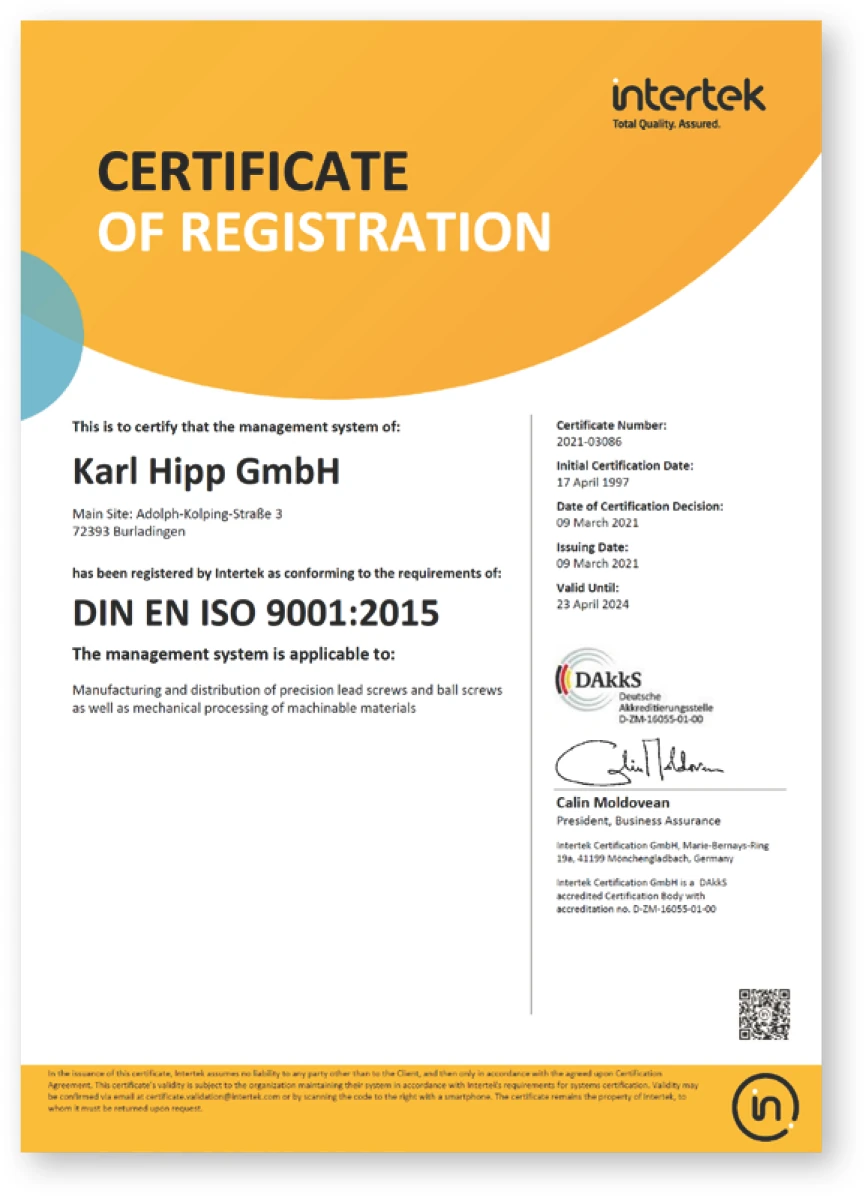
Karl Hipp GmbH · DIN EN ISO 9001:2015 certification (issued by Intertek)
Efficiency
Efficiency
We differentiate between theoretical and practical efficiency. Practical efficiency and the coefficient of friction depend on the following factors:
- Load
- Speed
- Lubrication
The following formulas are used to calculate a ballscrew's efficiency:
| Lead angle | tan α = P / (do · π) α = lead angle [°], P = lead [mm], do = ball reference circle [mm] |
|---|---|
| Torque converted to longitudinal force | η = tan α / tan (α + ρ) ρ = angle of friction [°], approx. 0.2° to 0.35° |
| Longitudinal force converted to torque | η' = tan (α − ρ) / tan α |
| Practical efficiency | ηp = η · 0.9 0.9 is the average value for load, speed and lubrication |
Rigidity
Rigidity
The rigidity of a ballscrew influences its geometric and positional accuracy. In our miniature ballscrews, we use a zero-play single nut with 4-point pre-loading to obtain very good rigidity values.
Static rating
Static rating
The static rating is an axial load acting concentrically, corresponding to a total permanent deformation of the ball or ball track of 0.0001 x the ball diameter at the most stressed contact area of the ball or ball track. In the stainless steel version, the static rating is reduced by approx. 20 percent.
Dynamic rating
Dynamic rating
The dynamic rating is the concentric axial load under which a ballscrew can attain a nominal life of 10 million circuits. In the stainless steel version, the dynamic rating is reduced by approx. 20 percent.
Radial loads
Radial loads
Radial loads may occur due to assembly tolerances, but they should be kept to below 5% of the smallest axial load.
Speeds
Speeds
When designing a ballscrew, attention should be paid to the critical bending speed – at this point, resonances occur at the spindle – and the maximum speed, both of which are determined to a large extent by the nut design and by the type of ball return system used.
Guidelines for maximum speeds [1/min]
| Lead [mm] | 4 | 6 | 8 | 10 | 12 | 16 | 20 | 25 | 32 | 40 |
|---|---|---|---|---|---|---|---|---|---|---|
| 0.5 | 4,000 | – | – | – | – | – | – | – | – | – |
| 1 | 4,500 | 4,500 | 3,200 | – | 1,800 | – | – | – | – | – |
| 2 | – | 4,500 | 4,200 | 4,000 | 3,400 | 3,000 | – | – | – | – |
| 2.5 | – | – | 4,200 | – | 3,400 | 3,000 | – | – | – | – |
| 3 | – | – | – | – | 3,400 | – | – | – | – | – |
| 4 | – | – | 4,200 | – | 3,600 | 4,000 | – | – | – | – |
| 5 | – | – | 4,000 | – | 3,600 | 4,200 | 4,000 | 3,800 | 3,500 | 2,700 |
| 10 | – | – | – | – | 3,600 | 4,200 | 4,000 | 3,800 | 3,500 | 3,000 |
"–" indicates that no corresponding value is provided in the original catalog.
See also
See also
Lifetime calculation, lubrication, assembly specifications, wiper and operating temperature
The above content belongs to the "Lifetime & Lubrication" chapter (Karl Hipp product catalog page 14 · Lifetime / Lubrication / Assembly specifications / Wiper / Operating temperature). For the full content, see the Lifetime, Lubrication & Assembly page.