7. Lubrication
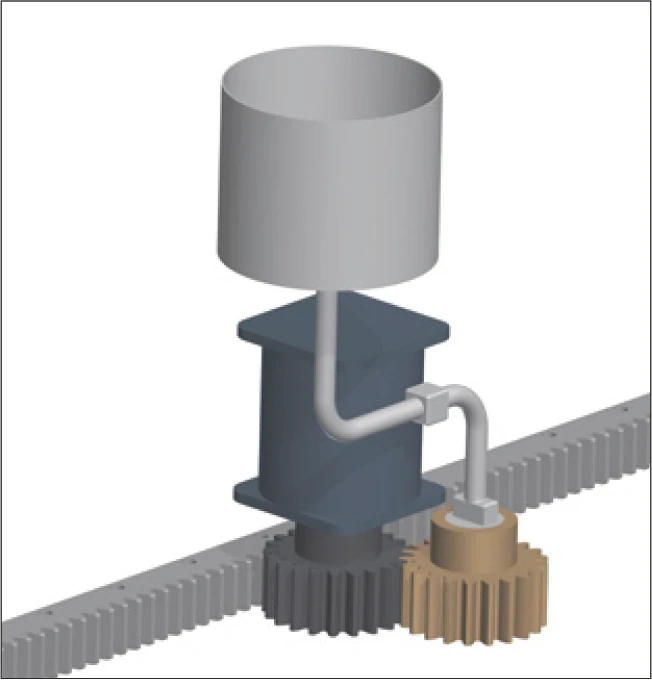
Lubrication device using a felt pinion
Sufficient lubrication with a lubricant suited to the operating conditions is necessary to ensure that the rack drive continues to work properly. Lubrication protects from wear and corrosion and reduces friction.
Apart from the initial lubrication during installation, the equipment must be re-lubricated regularly.
Electrically-driven lubrication cartridges are normally used for lubrication. Lubrication greases of NLGI 00 to NLGI 0 are applied to the drive pinion or the gear rack with a felt pinion. Please note that the felt pinion is subject to natural wear over time, and must therefore be checked at regular intervals and replaced if necessary.
Typical lubricant: Klüber Microlube GB 0
8. Pinion/gear rack operating conditions
You must ensure that the meshing between the pinion and the gear rack is set correctly.
When freewheeling, the guide block should be moved evenly over the whole length of travel (ensure that it has not been distorted during installation). With vertical axes, the machine table must be secured according to the instructions.
In the event of jams, the distance between the gear rack and the guide should be measured again using a dial gauge.
9. Maintenance
9.1 Shutting down, preparation
The machine in which the drive system is installed must be shut down during maintenance. The machine must be disconnected from the power supply before maintenance work. With vertical axes, the slideway must be secured according to the instructions.
9.2 Visual check
- Check the whole drive system for external damage and leaking lubrication by a thorough visual check
- The pinion and gear rack must be cleaned
- The whole drive system must be checked for external damage and leaks with a thorough visual check
- Defects or leaking parts must be repaired immediately
10. Dismantling
10.1 Preparatory measures
Shut down the machine in which the drive system is installed. The machine must be disconnected from the power supply before you start work. Ensure that it is possible to dismantle the gear system without any risk to people or the machine.
The gear racks and gear unit must only be dismantled by trained specialists with the necessary knowledge. With Z axes, the machine table must be secured as in the instructions, so that it does not drop due to its own weight and cause injury to people or damage to equipment.
The positive locking device on the machine table must be disconnected when dismantling the gear racks and the gear unit.
The fixing screws must be undone from the pinned fitting. After that, the gear rack can be carefully removed from the pinned fitting with a suitable tool.
10.2 Removing the gear rack
- Remove the gear racks carefully so as not to damage the gear system and adjacent parts
10.3 Replacing spare gear racks
- When replacing gear racks, use new screws and pins (see Section 5.2) and fit them into place
- Fit the spare gear racks into the gear rack set in accordance with Chapter 6, selecting the next larger dowel pins than specified in Section 5.2
- Ream all the holes to the correct tolerance dimension
- Finally, fix the gear racks with the dowel pins
11. Disposal
| Material category | Disposal method |
|---|---|
| Gaskets | Dispose of as composite materials (metal/plastic) |
| Metal |
Separate as far as possible into:
|
| Hoses | Dispose of in the same way as plastic |
| Felt gear wheels | Dispose of in the same way as residual oil-containing waste |
12. Tightening torques
The tightening torques specified below for headless screws (DIN EN ISO 898-1) are arithmetical values and do not apply to a friction factor of μ=0.125.
| Strength class | Tightening torque (Nm) | ||||||
|---|---|---|---|---|---|---|---|
| M6 | M8 | M12 | M16 | M20 | M30 | M36 | |
| 10.9 | 13 | 31 | 108 | 265 | 540 | 1970 | 3600 |
| 12.9 | 16 | 40 | 135 | 330 | 660 | 2300 | 4100 |
Screws of strength class 10.9 must be used for soft or induction hardened gear racks, and screws of strength class 12.9 for case-hardened and through-hardened gear racks.
A more even preload force is obtained if the screws are lubricated with a grease containing MoS2 and tightened using a torque wrench.