1.9.1 Definition
Guideways equipped with rolling bearings produce both airborne noise and structure-borne noise. The airborne noise produced directly by the bearings is secondary. The main noise is structure-borne noise excited by the structure on which the guideway is mounted.
1.9.2 Causes
The main sources of noise generation are elastic deformation at rolling element and guideway contact points, surface conformity, and lubricant effects.
Elastic Deformation
Due to the occurrence of impact-type loads, the contact points between rolling elements and guiding elements undergo deformation. In particular, when rolling elements enter and leave the carriage load zone, periodic oscillations occur, which produce running noise whose intensity and frequency increase with increasing speed.
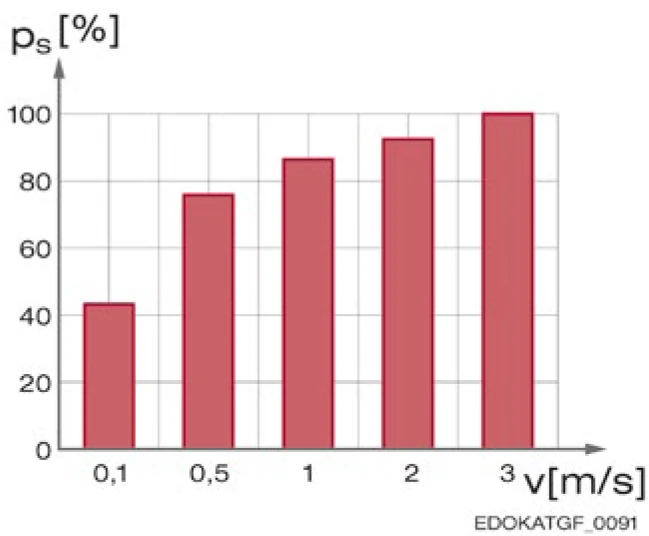
Sound pressure pS (%) as a function of velocity v (m/s) for ball guideway BM 25 with mineral oil lubrication
Chart description:
X-axis: v [m/s] - Velocity (meters per second)
Y-axis: pS [%] - Sound pressure (percentage)
Trend: Noise level increases significantly with increasing speed
Surface Effects
In addition to elastic deformation, the geometry of rolling contact also has an important influence on running noise. Different diameters of rolling elements, waviness, or surface irregularities all produce noise. These geometric variations cause uneven forces during rolling contact, which in turn cause vibration and noise.
Friction
The friction contact surfaces between rolling elements, between rolling elements and surrounding guiding elements, and between sealing elements all generate structure-borne noise through sliding friction and rolling friction. These friction contacts cause high-frequency vibrations that propagate through the guideway structure and are amplified by surrounding structures.
Lubricant
The lubricating film in the carriage has a noise-dampening effect, as it prevents direct mechanical contact between sliding surfaces and contact surfaces. The lubricating film forms a protective layer between contact surfaces, which can absorb some vibration energy, thereby reducing the noise produced by direct metal-to-metal impact. The thickness and viscosity characteristics of the lubricating film have a direct influence on noise reduction.
1.9.3 Measures to Reduce Noise
Lubricant
The thicker the lubricating film, the less metal contact and noise. Therefore, using special grease is an excellent method for noise reduction. SCHNEEBERGER recommends using NLGI grade 2 mineral oil-based greases with calcium soap or barium soap as thickeners, which can form a stable lubricating film on rolling element contact surfaces.
Proper grease not only reduces running noise but also extends guideway service life and improves running smoothness. The viscosity and thickener type of the grease affect the thickness and stability of the lubricating film, thereby directly affecting noise reduction. Compared to dry running or oil-only lubrication, using high-quality grease can significantly reduce noise levels.
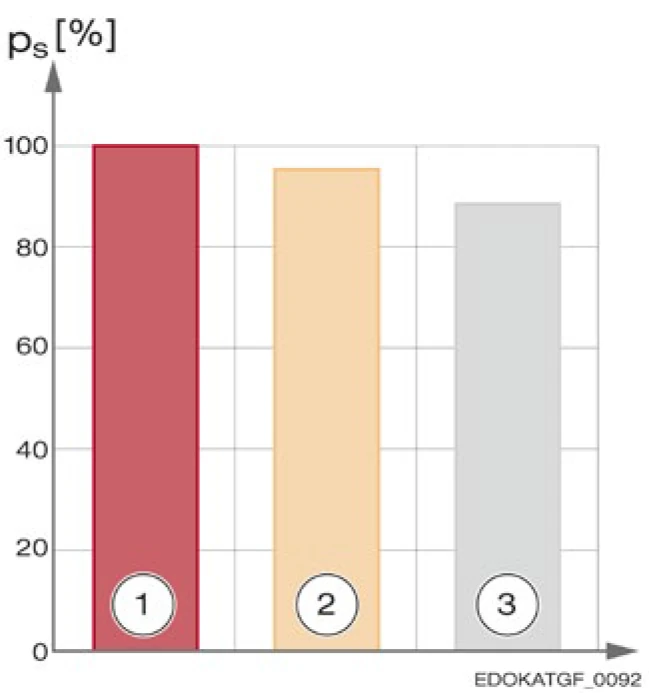
Sound pressure pS (%) as a function of lubrication condition for ball guideway BM 35
Legend:
Y-axis: pS [%] - Sound pressure (percentage relative to dry condition)
Conclusion: Using grease can significantly reduce running noise by approximately 12%
Surface Treatment
To reduce running noise caused by metal contact between rolling elements and surrounding guiding elements, in the case of linear guideways, special attention should be paid to reducing surface roughness of contact surfaces. Smoother surfaces can reduce vibration excitation during contact, thereby reducing noise levels.
Therefore, SCHNEEBERGER not only manufactures roller carriages but also ball carriages with plastic return channels, which helps reduce noise. Plastic return channels, compared to metal channels, can absorb more vibration energy and provide smoother transitions when rolling elements enter and leave the load zone.
Additionally, some carriage designs also include additional lubricant storage reservoirs that can provide continuous lubricant supply to rolling elements, ensuring sufficient lubricating film thickness is maintained throughout operation. This design not only reduces noise but also improves overall running performance.
Spacers
In addition to the effective noise reduction measure of using lubricant, SCHNEEBERGER also offers the option of adding spacers between balls for BM ball guideways. This is a mechanical solution specifically designed to reduce noise.
These prevent the rolling elements from rubbing against one another or from being able to impact upon one another. Spacers unlike chains have the advantage that they are only subjected to pressure and, due to the absence of connecting bars, no flexural or tensile stresses can occur, which has a positive impact on service life and wear.