The cage has the task of keeping the balls in the ball bearing separated from each other around the pitch circle of the bearing. To find the optimum solution for each application, myonic has developed many different cage designs, differing in both construction and material.
Cage Selection Criteria
Per the official myonic Ball cages page, the following requirements must be taken into account when selecting the most suitable cage:
| # | Requirement |
|---|---|
| 1 | Starting and running friction torque |
| 2 | Speeds |
| 3 | Acceleration and deceleration |
| 4 | Operating temperature |
| 5 | Type and quantity of lubricant |
| 6 | Ambient conditions during use (vacuum, chemicals, etc.) |
| 7 | Noise emission requirements |
| 8 | External vibrations |
| 9 | Self-lubricating |
There is no cage that meets all conceivable requirements; please contact myonic application engineers for actual selection.
Metallic Cages
Standard Model 480
The standard metallic cage is made from two pieces of tightly crimped steel ribbon and is the standard configuration for most miniature radial ball bearings.
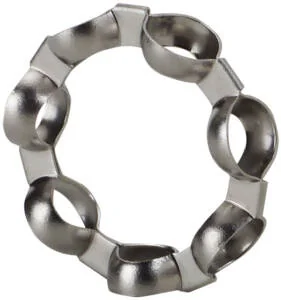
Standard steel ribbon cage (Model 480)
| Characteristic | Specification |
|---|---|
| Material | Steel ribbon |
| Manufacturing Process | Precision stamping |
| Max Speed (n·Dm) | ≤ 400,000 |
| Friction Characteristics | Standard |
| Applications | Standard industrial applications |
Low-Friction Model 48
A loosely crimped two-piece steel ribbon cage, suitable for low starting torque applications.
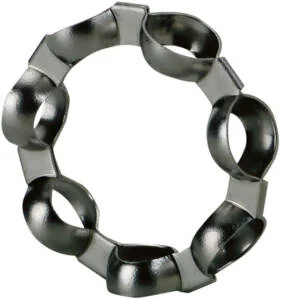
Low friction steel ribbon cage (Model 48)
Improvements compared to Standard Model 480:
- Low starting friction torque, prevents sticking
- Model “48” is designed for applications requiring low frictional torque or relatively low speeds
- Please contact our technical department for speeds above 5,000 rpm (technical consultation required above 5,000 rpm)
Synthetic Material Cages
For high-speed and ultra-high-speed applications, myonic offers various synthetic material cages, manufactured by precision machining or injection molding.
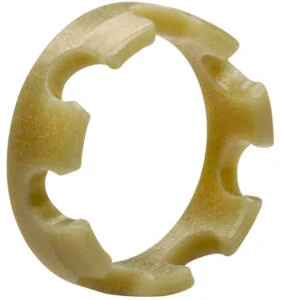
High-speed machined cage (Model 23)
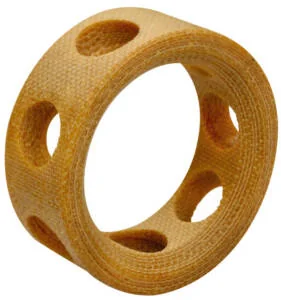
Angular contact high-speed cage (Model 25)
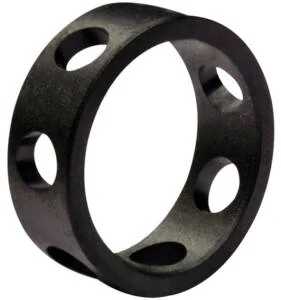
Ultra-high-speed cage (Model 27)
High-Speed and Special Material Cage Comparison
| Model | Material | Manufacturing Process | Max Speed (n·Dm) | Characteristics |
|---|---|---|---|---|
| 27 | Synthetic material | Machined or injection moulded (derived from model 25 structure) | ≤ 2,400,000 | Ball pockets drilled through; lower friction than Model 25, suitable for ultra-high speeds |
| 25 | Synthetic material | Injection molding or machining | ≤ 1,500,000 | One-piece design, specially designed for RA and RKA series angular contact ball bearings. Ball pocket design allows the inner ring to be removed without the balls falling out, so the two rings can be mounted separately. An oil-impregnated version is available to extend service life under insufficient lubrication conditions. |
| 23 | Synthetic material (crown or comb) | Machining or injection molding | ≤ 1,300,000 | Can be oil-impregnated |
Cage Materials
In addition to metallic materials, myonic offers many synthetic materials for cages, including:
- Corrosion-resistant steel
- Laminated fabric
- PAI (polyamide-imide)
- PI (polyimide)
- PEEK (polyether ether ketone)
- PA (polyamide)
- PTFE (polytetrafluoroethylene)
- POM (polyoxymethylene)
- Laminated paper
Each material has its advantages depending on the area of application, lubrication and operating environment. Please contact myonic application engineers for the best choice of cage material.
Customized Cage Designs
If the standard cages above cannot meet a customer's requirements, myonic can also design customized cages according to customer specifications. myonic continuously develops new materials and new cage designs.
Two-Part Crimped Steel Cage — Coated Version
For cases where conventional lubricants are not suitable, both the two-piece standard cage Model 480 and Model 48 can be coated with a fine layer of Teflon or other materials that have a self-lubricating effect.
Official Applications for Teflon-Coated Cages
Per the official myonic Ball cages page, Teflon-coated cages are used for the following scenarios:
- Applications requiring very long storage times
- Instruments that work in a vacuum
- Optical systems
For assistance selecting the most suitable cage solution, please contact our sales engineers or application engineers.